Daily Energy Use and Carbon Emissions
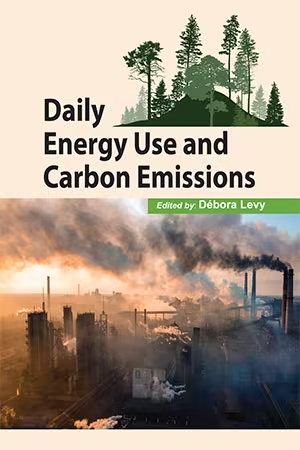
Débora Levy | 2023 | ISBN: 1682508455 | English | 292 pages | True PDF | 12 MB
In today’s world one of the biggest issue faces by all of us is global warming. Global warming refers to an increase in average global temperatures. Global warming is a fact, and evolves into a full range of issues of politics, economy, society, technology, environment and ecology on a global scale from a single scientific problem. It becomes one of the tremendous challenges for human being. Global warming and a series of problems have aroused intense concerns of the international community. The main cause of global warming is increasing in the concentration of greenhouse gases (GHGs) in the atmosphere due to anthropogenic activities and their level is quantified with the help of global warming potential (GWP) and expressed as Carbon Footprint (CF). The link among energy use, human welfare, and carbon emission has been a topical issue. Energy consumption has been on the increase owing to the production and consumption of sophisticated consumer goods and home appliances. Increased energy use triggers carbon emission that is detrimental to human welfare. Carbon capture and storage (CCS) is broadly recognized as having the potential to play a key role in meeting climate change targets, delivering low carbon heat and power, decarbonizing industry and, more recently, and its ability to facilitate the net removal of C02 from the atmosphere. However, despite this broad consensus and its technical maturity, CCS has not yet been deployed on a scale commensurate with the ambitions articulated a decade ago. In spite of recent issues surrounding climate change data and its handling, there is little doubt that our massive geo-engineering experiment of increasing greenhouse gas concentrations in the atmosphere will have undesirable consequences for the environment and for human health. To reduce the rate of change, it will be essential to deploy all emissions reduction techniques.
Thus, in this book we review the current state-of-the-art of C02 capture, transport, utilization and storage from a multi-scale perspective, moving from the global to molecular scales. This book covers topics such as daily water use, renewable energy, water and energy sources, transportation, concrete and steel, and carbon capture and storage. Ever since industrialization occurred, there has been an increase in the burning of fossil fuels to meet the high energy demands. The use of such fuels causes emission of carbon dioxide (CO2) and other greenhouse gases which lead to global warming. Such a warming may have a highly injurious impact to life on Earth. One way to alleviate this is to reduce the use of such fuels. An alternative method is to capture and store the emitted CO2 to stop it from polluting the atmosphere. This is known as carbon capture and storage. This book discusses the methods and economics associated with the same. This book will be of helpful for students and instructors in Environmental Engineering programs, and an essential read for those pursuing careers in areas related to energy, environment, and climate change.
Quick check before we show the links
Helps us keep automated scrapers from hammering the filehosts.