Natural Language Processing & Deep Learning: Zero to Hero
This post was published 5 years ago. Download links are most likely obsolete. If that's the case, try asking the uploader to re-upload.

Genre: eLearning | MP4 | Video: h264, 1280x720 | Audio: AAC, 44.1 KHz
Language: English | VTT | Size: 8.43 GB | Duration: 15h 29m
Linguistics & Machine Learning: Grammar Syntax, Sentiment, ScrapeTweets, RNN/LSTM,Chatbot, SQuAD, Summary, Audio To Text
What you'll learn
Libraries: Tensorflow, Pytorch, NLTK, SpaCy, Sci-kit Learn, Twint
Linguistics Foundation To Help Learn NLP Concepts
Deep Learning: Neural Networks, RNN, LSTM Theory & Practical Projects
Machine Reading Comprehension: Create A Question Answering System with SQuAD
No Tedious Anaconda or Jupyter Installs: Use Modern Google Colab Cloud-Based Notebooks for using Python
How To Build Generative AI Chatbots
Create A Netflix Recommendation System With Word2Vec
Perform Sentiment Analysis on Steam Game Reviews
Convert Speech To Text
Machine Learning Modelling Techniques
Markov Property - Theory & Practical
Optional Python For Beginners Section
Cosine-Similarity & Vectors
Word Embeddings: My Favourite Topic Taught In Depth
Scrape Unlimited Tweets Using An Open Source Intelligence Tool
Speech Recognition
LSTM Fake News Detector
Context-Free Grammar Syntax
Scrape Wikipedia & Create An Article Summarizer
Description
This course takes you from a beginner level to being able to understand NLP concepts, linguistic theory, and then practice these basic theories using Python - with very simple examples as you code along with me.
Get experience doing a full real-world workflow from Collecting your own Data to NLP Sentiment Analysis using Big Datasets of over 50,000 Tweets.
Data collection: Scrape Twitter using: OSINT - Open Source Intelligence Tools: Gather text data using real-world techniques. In the real world, in many instances you would have to create your own data set; i.e source your data instead of downloading a clean, ready-made file online
Use Python to search relevant tweets for your study and NLP to analyze sentiment.
Language Syntax: Most NLP courses ignore the core domain of Linguistics. This course explains the fundamentals of Language Syntax & Parse trees - the foundation of how a machine can interpret the structure of s sentence.
New to Python: If you are new to Python or any computer programming, the course instructions make it easy for you to code together with me. I explain code line by line.
No Installs, we go straight to coding - Code using Google Colab - to be up-to-date with what's being used in the Data Science world 2021!
The gentle pace takes you gradually from these basics of NLP foundation to being able to understand Mathematical & Linguistic (English-Language-based, Non-Mathematical) theories of Deep Learning.
Natural Language Processing Foundation
Linguistics & Semantics - study the background theory on natural language to better understand the Computer Science applications
Pre-processing Data (cleaning)
Regex, Tokenization, Stemming, Lemmatization
Name Entity Recognition (NER)
Part-of-Speech Tagging
Libraries:
NLTK
Sci-kit Learn
Tensorflow
Pytorch
SpaCy
DeepPavlov
Twint
The topics outlined below are taught using practical Python projects!
Parse Tree
Markov Chain
Text Classification & Sentiment Analysis
Company Name Generator
Unsupervised Sentiment Analysis
Topic Modelling
Word Embedding with Deep Learning Models
Open Domain Question Answering (like asking Google)
Closed Domain Question Answering (Like asking a Restaurant-Finder bot)
LSTM using TensorFlow, Keras Sequence Model
Speech Recognition
Convert Speech to Text
Neural Networks
This is taught from first principles - comparing Biological Neurons in the Human Brain to Artificial Neurons.
Practical project: Sentiment Analysis of Steam Reviews
Word Embedding: This topic is covered in detail, similar to an undergraduate course structure that includes the theory & practical examples of:
TF-IDF
Word2Vec
One Hot Encoding
gloVe
Deep Learning
Recurrent Neural Networks
LSTMs
Get introduced to Long short-term memory and the recurrent neural network architecture used in the field of deep learning.
Build models using LSTMs
Who this course is for:
Anyone who is curious about data science & NLP
Those who are in the Business & Marketing world - learn use NLP to gain insight into customers & products. Can help at interviews & job promotions.
If you intend to enrol in an NLP/Data Science course but are a total newbie, complete this course before to avoid being lost in class since it can seem overwhelming if classmates already have a foundation in Python or Datascience.
Screenshots
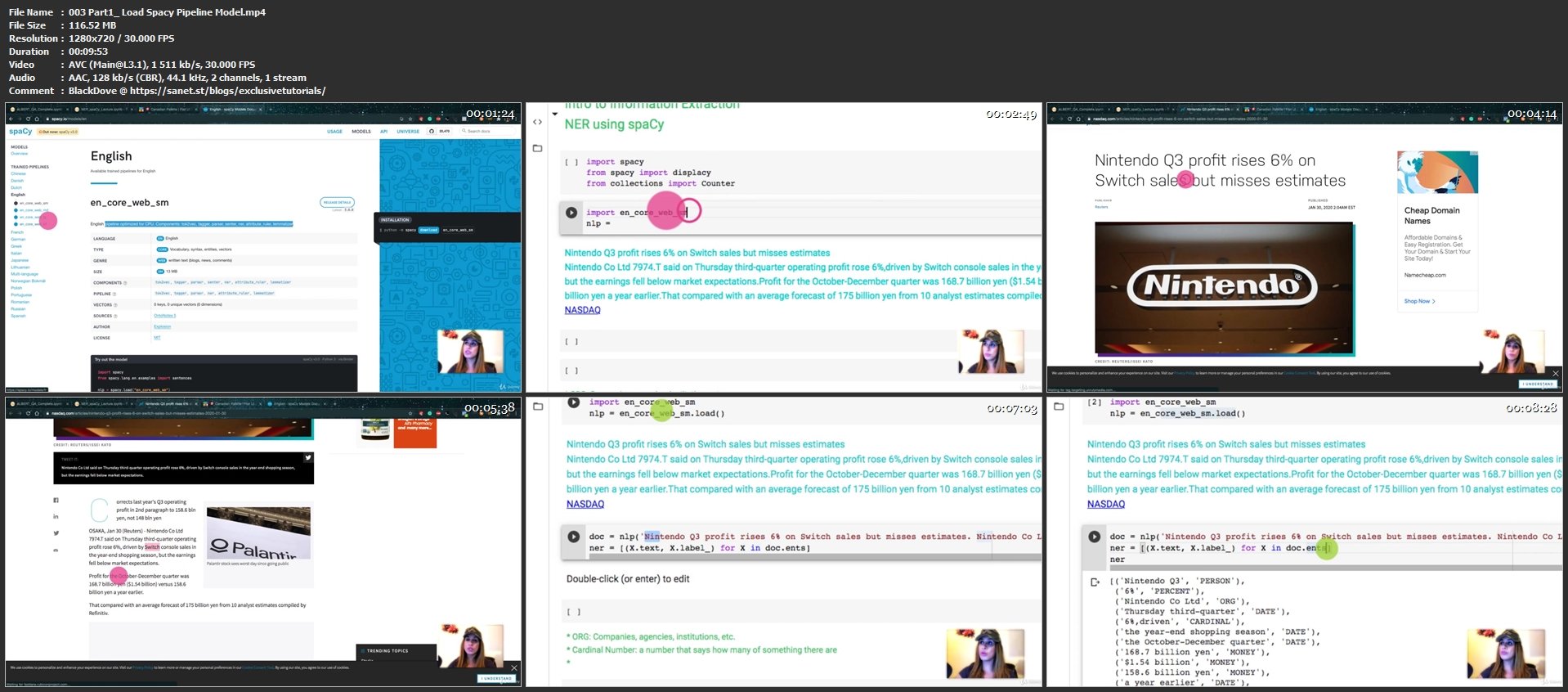
Homepage
Without You And Your Support We Can’t Continue
Thanks For Buying Premium From My Links For Support
Click >> Here & Visit My Blog Daily For More Udemy Tutorial. if You Need Update or Links Dead Don't Wait Just PM Me or Leave Comment at This Post
Quick check before we show the links
Helps us keep automated scrapers from hammering the filehosts.