Exploring Frequency Distribution Tables ( Part-I )
This post was published 2 years ago. Download links are most likely obsolete. If that's the case, try asking the uploader to re-upload.

Published 7/2023
MP4 | Video: h264, 1280x720 | Audio: AAC, 44.1 KHz
Language: English | Size: 1.18 GB | Duration: 1h 9m
How to form Frequency Distribution Table
What you'll learn
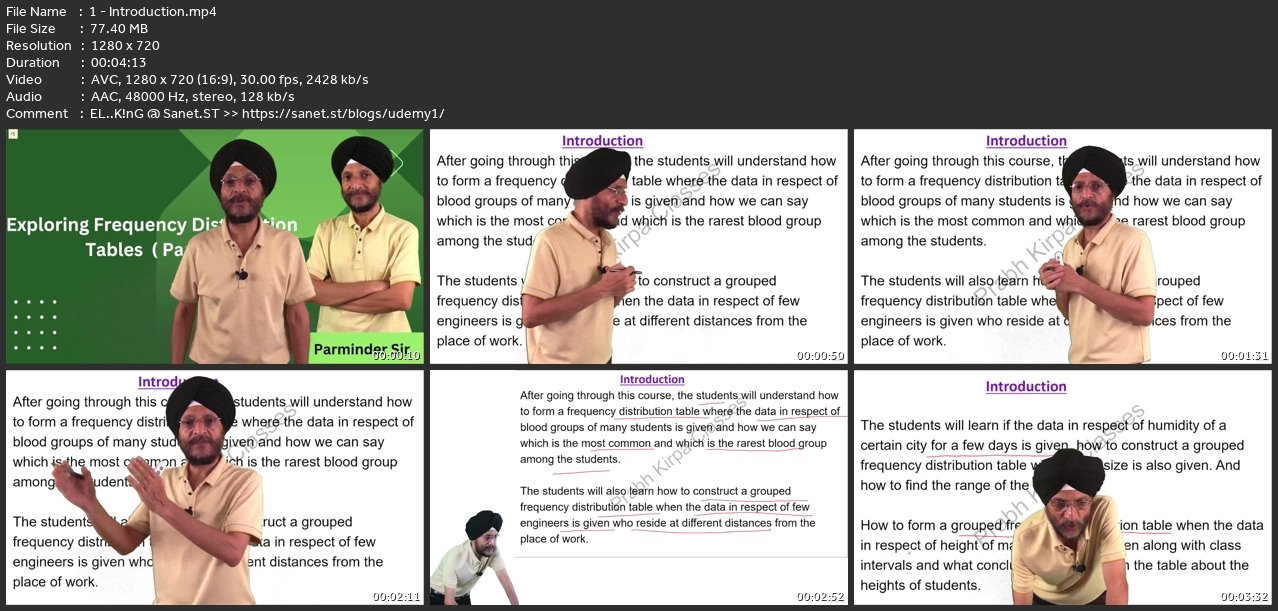
How to form a frequency distribution table where the data in respect of blood groups of many students is given and how we can say which is the most common an
How to construct a grouped frequency distribution table when the data in respect of few engineers is given who reside at different distances from the place o
If the data in respect of humidity of a certain city for a few days is given, how to construct a grouped frequency distribution table when class size is also
How to form a grouped frequency distribution table when the data in respect of height of many students is given along with class intervals.
Requirements
Basic knowledge of Algebra and Geometric concepts
Description
How to form a frequency distribution table where the data in respect of blood groups of many students is given and how we can say which is the most common and which is the rarest blood group among the students.How to construct a grouped frequency distribution table when the data in respect of few engineers is given who reside at different distances from the place of work. If the data in respect of humidity of a certain city for a few days is given, how to construct a grouped frequency distribution table when class size is also given. And how to find the range of the data?How to form a grouped frequency distribution table when the data in respect of height of many students is given along with class intervals and what conclusion we draw from the table about the heights of students.When the large amount of data is to be presented, we can condense the data in to groups and these groupings are called “classes” or “class-intervals” and their size is called the class-size or class width. In each of these groupings/classes, the least number is called the lower class limit and the greater number is called the upper class limit.
Overview
Section 1: Introduction
Lecture 1 Introduction
Section 2: Exploring Frequency Distribution Tables ( Part-I )
Lecture 2 Frequency Distribution table of students
Lecture 3 Frequency Distribution table of engineers
Lecture 4 Frequency distribution table - relative humidity
Lecture 5 Frequency distribution table: heights of students
Students and any individual who enjoys learning about various mathematical concepts
Screenshots
Homepage
without You and Your Support We Can’t Continue
Thanks for Buying Premium From My Links for Support
Click >>here & Visit My Blog Daily for More Udemy Tutorial. If You Need Update or Links Dead Don't Wait Just Pm Me or Leave Comment at This Post
Quick check before we show the links
Helps us keep automated scrapers from hammering the filehosts.